
SEATELSAT initiated this crucial initiative as a collaborative proof of concept (POC) to address a significant challenge in Indonesia: extending the effective reach of existing government-provided satellite internet access (RTGS). The original Wi-Fi infrastructure limited connectivity to a small area and was unavailable after school hours.
We viewed this as a strategic opportunity to deploy specialized technology. Our role was to provide the financing and technical integration for the solution. The trial successfully demonstrated the technical and economic viability of using the currently unutilized LTE 450MHz frequency (Band 31) to drastically expand coverage and maximize the usage of the geo satellite capacity.
The POC was successfully implemented by Seatelsat in two sites in rural Southern Sulawesi and concluded on December 9th, 2024, meeting all established objectives.
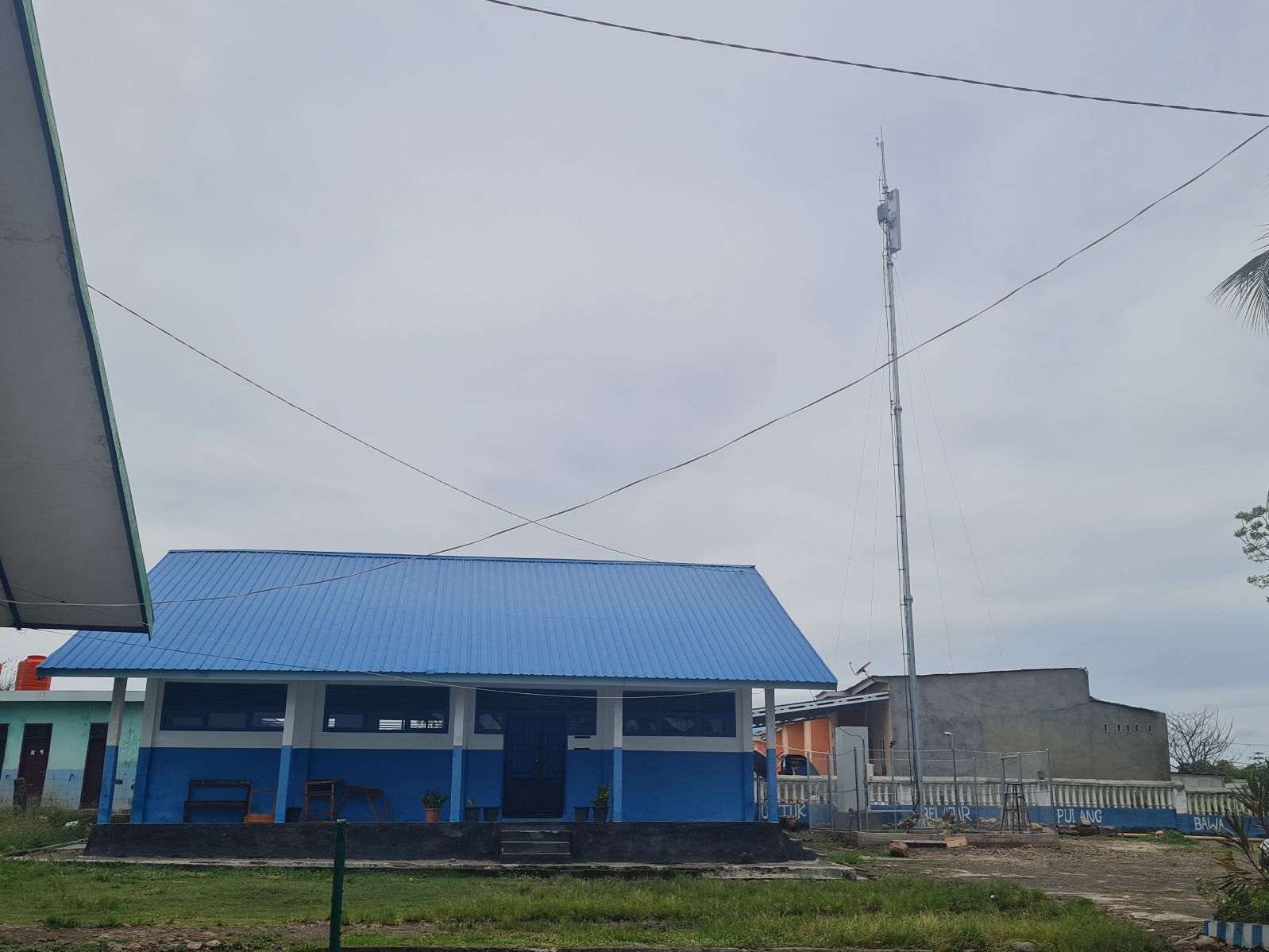
Our approach was centered on leveraging low-band frequency and proving integration feasibility. The POC was executed on two sites in rural Southern Sulawesi (Jeneponto and Gorontalo).
The project successfully addressed a major technical hurdle: connecting the LTE system’s Layer 2 backhaul requirement through the Geo Satellite network, which was originally designed only for Layer 3 traffic. We achieved this integration by successfully implementing an L2/L3 Ethernet over IP (EOIP) tunnel via Mikrotik routers. This verified that the Geo satellite network can be reliably utilized for LTE Network Backhaul purposes.
The network components proved highly reliable during the 2.5-week trial period. BTS Availability was robust, averaging 98.3% in Jeneponto and 99.4% in Gorontalo. This resilience is a core advantage of using low-band technology. The trial also confirmed superior technical performance, showing the LTE 450MHz network (with 5 MHz bandwidth) could reach a cell throughput of up to 29 Mbps downlink and 8 Mbps uplink in Jeneponto.
The utilization of the currently unused LTE 450MHz (Band 31) frequency was key to solving the coverage issue. The LTE 450 MHz BTS, mounted on a 20-meter tower, provided coverage with reasonable data speed at a range of up to 5 km, with the potential to reach 10 km using new CPE and Yagi antennas. This coverage proved superior to the 900 MHz signal, which was limited to only up to 2 km. The resulting signal fully covered the schools and madrassas, where existing Access Points had only covered two buildings.
The primary success of the POC was proving the model for increasing the utilization of the existing government infrastructure.
The deployment enabled the community outside the school to access the internet, which was previously impossible. This generated significant additional payload outside the normal school busy hours, increasing the RTGS utilization.
This data proves that the LTE 450 MHz solution enables the BAKTI internet access site effective production to be increased by 2x.
The extended coverage delivered immediate benefits to the local community, fundamentally supporting the “Empowering” mission:
This successful trial confirms a clear use-case for scaling this solution across the national infrastructure program. The LTE 450 MHz network is ready to support future use cases, including Deploying IOT on 450 MHz and utilizing the higher capacity Fiber Optic Backhaul (as opposed to geo satellite) to further increase internet access speeds in rural areas.
Lorem ipsum dolor sit amet, consectetur adipiscing elit. Duis tincidunt molestie egestas. Morbi ac nibh sem. Mauris orci augue, molestie at tellus vitae, maximus malesuada urna. Aliquam gravida semper efficitur. Aliquam tincidunt iaculis eleifend. Duis consectetur leo ante, id lobortis mi ultrices vel. Quisque et semper mauris. Praesent eget libero nec nisi euismod porttitor. In eget lectus tincidunt, tincidunt turpis sit amet, mattis risus.